
Situation Update: Cambodia’s Real Estate Market & Prospect 2026: A Data-Driven Outlook Amid Border Tensions, Local Reforms and Global Uncertainties
Cambodia enters 2026 at a pivotal point in its real-estate cycle. After a decade of rapid expansion, the market is transitioning into a more disciplined and selective phase—shaped by slower but positive economic growth, regulatory reform, new infrastructure, and evolving regional dynamics.
This article provides a data-driven assessment of Cambodia’s real-estate outlook in 2026, integrating macroeconomic trends, tourism dynamics, legal and tax reforms, and sector-specific strategies for investors.
1. Macroeconomic Outlook: Growth Continues, Momentum Normalises
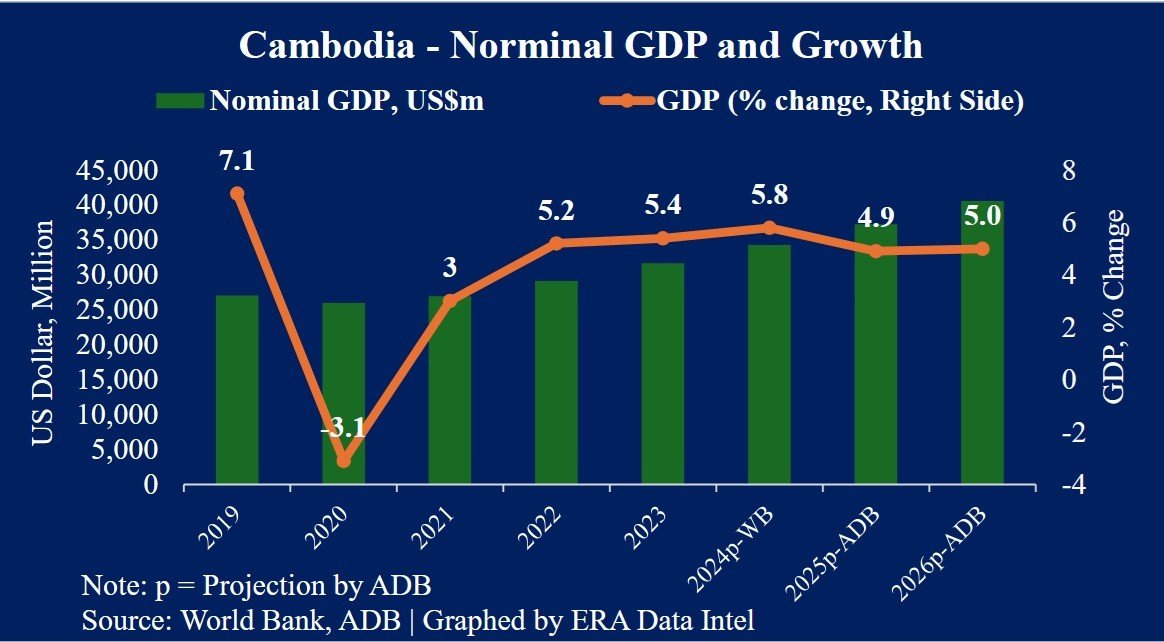
Cambodia remains one of Southeast Asia’s faster-growing economies, but growth is moderating from its pre-pandemic pace.
2010–2019: Average GDP growth of 6–7%
2023–2024: Post-COVID recovery above 5%
2026 outlook: ~4.5–5.0%, based on IMF and ADB projections
This moderation reflects global trade uncertainty, softer tourism momentum in 2025, and tighter financial conditions linked to property-sector adjustment. Importantly, this is not a recessionary scenario, but a normalisation phase where investment performance depends more on asset fundamentals than market momentum.
2. Tourism: Recovered, Adjusted, and Moving Toward Stabilisation
> Recovery Achieved
Cambodia’s tourism sector demonstrated strong resilience:
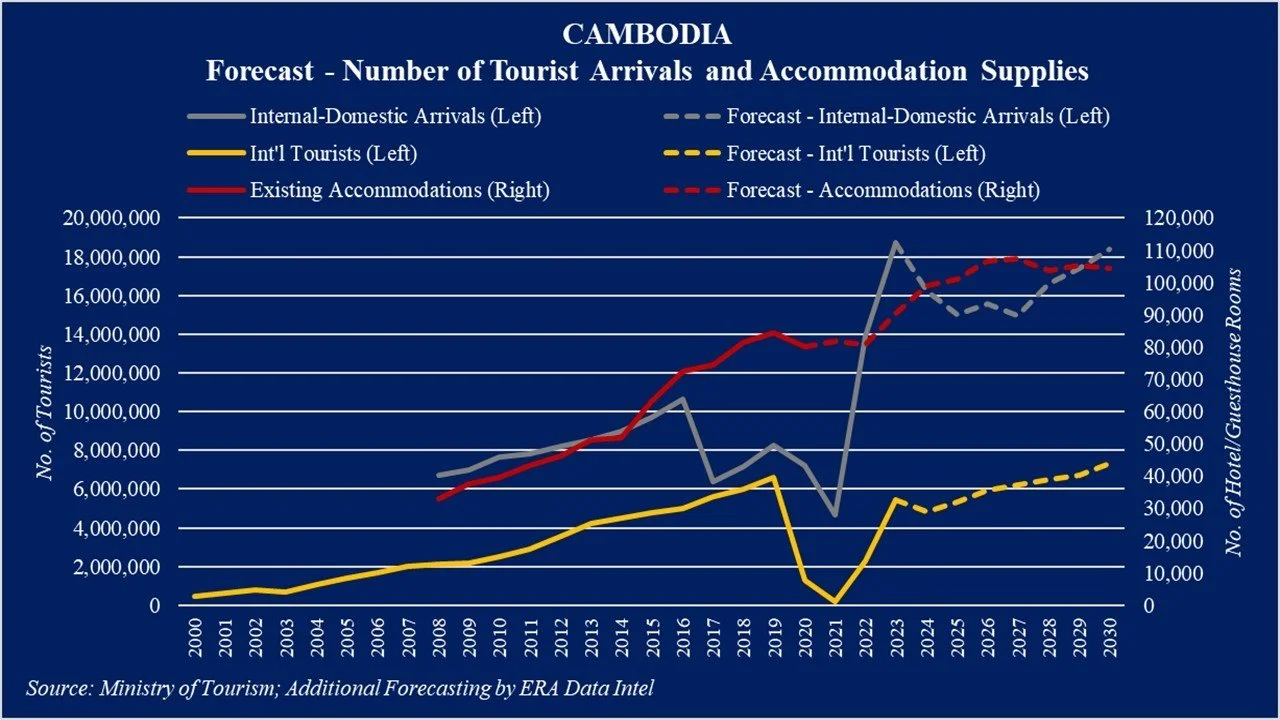
2019: ~6.6 million international visitors
2023: ~5.45 million
2024: ~6.7 million — effectively back to pre-COVID levels
This recovery supported employment, hospitality revenues, and rental demand in Phnom Penh, Siem Reap, and coastal markets.
> 2025 Adjustment
Official data shows year-on-year declines in parts of 2025, driven by:
Cambodia–Thailand border tensions affecting short-haul travel
Heightened international scrutiny related to scam-economy enforcement
Broader global uncertainty dampening discretionary travel
These headwinds are largely cyclical, not structural.
> 2026 Outlook
Most government and industry expectations point to stabilisation in 2026, with arrivals likely to:
Base case: ~6.7–7.1 million
Upside case: ~7.1–7.5 million if regional conditions improve
Key structural supports include:
Techo International Airport, operational from late 2025
Siem Reap–Angkor International Airport
Continued diversification toward China, ASEAN, and eco-tourism
Strong domestic tourism cushioning volatility
3. Infrastructure: Aviation as a Long-Term Catalyst
Techo International Airport fundamentally changes Cambodia’s tourism and logistics capacity:
Phase 1 capacity: ~13 million passengers/year
Future expansion to 30 million and 50 million passengers
While aviation capacity alone does not guarantee higher property prices, it raises the long-term ceiling for:
Hospitality and serviced apartments
Retail and lifestyle assets
Industrial and logistics developments along airport and expressway corridors
4. Politics, Geopolitics, and Risk Perception
Cambodia remains politically stable, with strong policy continuity.
Recent challenges—including border tensions and international sanctions linked to scam-economy enforcement—have affected sentiment and compliance processes, but:
Core urban markets remain insulated
Risks are primarily confidence-based, not systemic
For investors, this underscores the importance of counterparty due diligence, not market withdrawal.
5. Legal & Tax Reforms: A More Mature Market Framework
Key developments shaping 2026 investment strategy:
Foreign ownership of strata-title condominiums remains permitted
4% transfer tax continues to apply
20% Capital Gains Tax (CGT) on property sales effective January 2026
CGT encourages:
Longer holding periods
Yield-focused investment
Greater emphasis on asset quality and liquidity
This aligns Cambodia more closely with other ASEAN property markets.
6. Real-Estate Market Fundamentals: From Expansion to Selection
Residential Condominiums
Phnom Penh condo stock has expanded sharply since 2019
Oversupply exists in certain investor-driven segments
Resilience remains in prime locations, well-managed buildings, and practical unit sizes
Landed Housing
Borey developments perform best when aligned with local affordability
Speculative fringe developments face slower absorption
Industrial & Logistics
This is the strongest-performing segment across scenarios, supported by:
Airport infrastructure
Supply-chain diversification
Manufacturing and logistics demand
Hospitality & Serviced Apartments
Short-term volatility suggests conservative underwriting, but long-term fundamentals remain supported by improved connectivity and urbanisation.
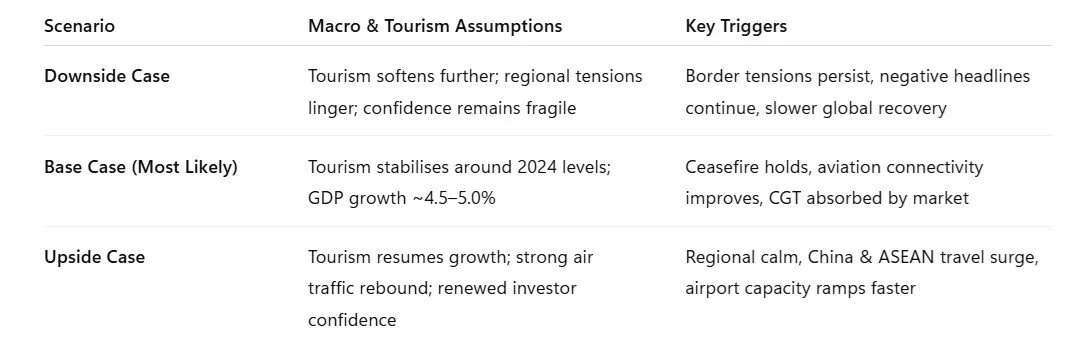
7. 2026 Scenario Matrix: Strategy by Asset Type
Macro & Tourism Scenarios
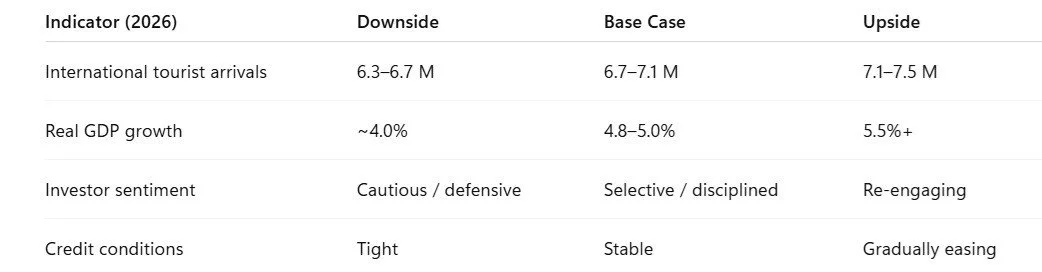
Downside: Tourism 6.3–6.7M | GDP ~4.0%
Base case (most likely): Tourism 6.7–7.1M | GDP ~4.8–5.0%
Upside: Tourism 7.1–7.5M | GDP >5.5%
Strategic Implications
Condominiums: Income-focused, prime-only selection
Luxury residences: Scarcity and long-term capital preservation
Serviced apartments: Selective positioning near business and tourism nodes
Landed housing: Mid-market, end-user driven projects
Industrial & logistics: Core allocation across all scenarios
Scenario Matrix Overview
Tourism & Macro Indicators by Scenario
Conclusion: 2026 Is a Selection Market, Not a Retreat
Cambodia’s real-estate market in 2026 is best understood as a discipline-driven cycle:
Economic growth continues at a sustainable pace
Tourism has recovered, adjusted, and is stabilising
Infrastructure investments strengthen long-term fundamentals
Legal reforms promote transparency and maturity
For investors, success in 2026 will depend on quality, income visibility, and risk management—not speculation.
This is not a market to exit, but one that rewards precision, patience, and professional analysis.
Contact for Advisory
For a confidential consultation, please reach out:
Call: +855-10-699-553
Telegram: t.me/hoemseiha_era
WhatsApp: wa.me/85510699553
Line ID: hoemseiha
Email: hoem.seiha@eracambodia.com
More condo listings: t.me/seiha_era_condo_listing